🚚 Free Worldwide Shipping on All Orders!Shop Now

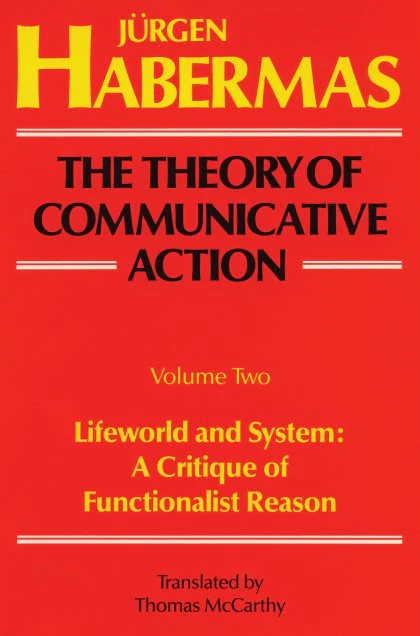
The Theory of Communicative Action: Volume 2
Juergen Habermas opens Volume 2 with a brilliant reinterpretation of Mead and Durkheim and then develops his own approach to society, combining two hitherto competing paradigms, "system" and "lifeworld." The strength of this combination is then demonstrated in a detailed critique of Parsons's theory of social systems. Concluding with a critical reconstruction of the Weberan and Marxian treatment of modernity and its discontents, Habermas sets a new agenda for the critical theory of contemporary society. The combination of historical and theoretical sweep, analytical acumen and synthetic power, imagination and engagement mark this as one of the great works of twentieth-century social theory.
Juergen Habermas opens Volume 2 with a brilliant reinterpretation of Mead and Durkheim and then develops his own approach to society, combining two hitherto competing paradigms, "system" and "lifeworld." The strength of this combination is then demonstrated in a detailed critique of Parsons's theory of social systems. Concluding with a critical reconstruction of the Weberan and Marxian treatment of modernity and its discontents, Habermas sets a new agenda for the critical theory of contemporary society. The combination of historical and theoretical sweep, analytical acumen and synthetic power, imagination and engagement mark this as one of the great works of twentieth-century social theory.
$39.97
The Theory of Communicative Action: Volume 2—
$39.97
Description
Juergen Habermas opens Volume 2 with a brilliant reinterpretation of Mead and Durkheim and then develops his own approach to society, combining two hitherto competing paradigms, "system" and "lifeworld." The strength of this combination is then demonstrated in a detailed critique of Parsons's theory of social systems. Concluding with a critical reconstruction of the Weberan and Marxian treatment of modernity and its discontents, Habermas sets a new agenda for the critical theory of contemporary society. The combination of historical and theoretical sweep, analytical acumen and synthetic power, imagination and engagement mark this as one of the great works of twentieth-century social theory.


